The Anatomy of a Winning Cover Letter: Writing Your Story in 300 Words
A generic, copy-pasted cover letter is a wasted opportunity to contextualize your career. This guide outlines a mathematically disciplined, 300-word structural framework that captures immediate attention, presents your high-impact metrics, and answers the employer's pressing business needs on a single page.
RESUME WRITING
Updated 8 July 2026
7/7/20264 min read
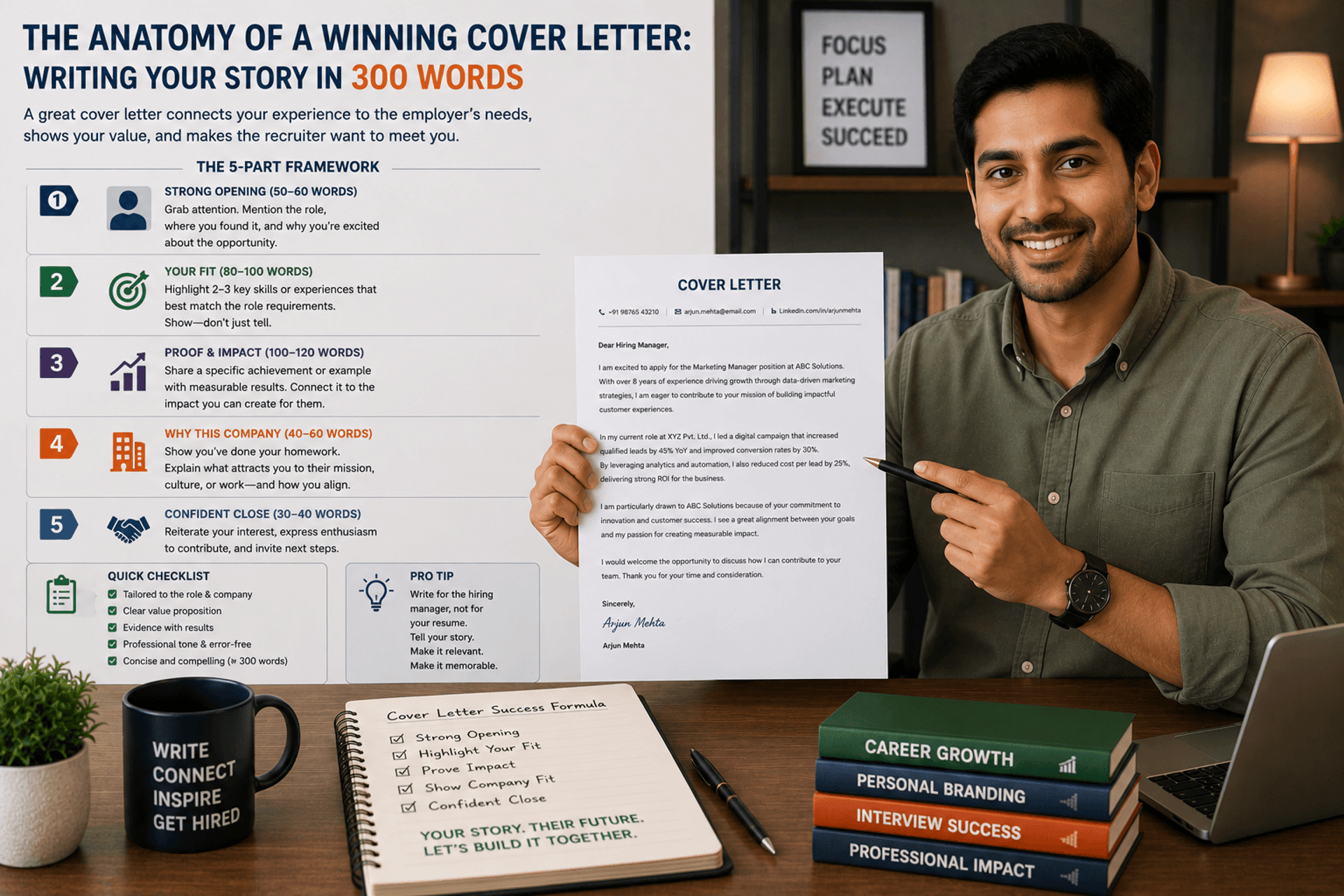
Writing Resume in 300 Words

Introduction
A cover letter should never read like a dry, chronological summary of your resume. Repeating the exact same bullet points in paragraph form tires the reader and fails to add any new depth to your professional profile.
The true purpose of a cover letter is to bridge the gap between your historical data and the employer's future goals. Writing a high-impact, targeted narrative allows you to explain the "why" behind your career milestones, highlight your specialized domain expertise, and directly address the company's distinct operational pain points.
The 300-Word Structural Blueprint
An elite cover letter relies on structural brevity. It must fit comfortably on a single page, broken down into four distinct, highly intentional text blocks.
1. The Hook & Core Mandate Alignment (40–50 Words)
Skip generic pleasantries like "I am writing to express my interest in your open role." Instead, open immediately with your professional tenure, your core specialization, and the exact problem you intend to solve for the company.
Example: "With over six years of accelerated experience in digital product management, I specialize in scaling user retention pipelines. I am tracking your team's expansion into cross-border fintech infrastructures, and I aim to deploy my optimization frameworks to accelerate your immediate growth milestones."
2. The Core Metric Deep-Dive (100–120 Words)
This section houses your single highest-impact professional outcome. It must expand on one major achievement from your resume, walking the reader through the baseline challenge, the exact methodology you used, and the final business metric you delivered.
Example: "During my recent tenure at Enterprise Solutions, I stepped into a fragmented data environment where customer onboarding delays were averaging twelve business days. By overhauling our data engineering infrastructure and deploying automated data migration pipelines, I restructured our entire integration cycle. This systematic modernization condensed onboarding times by 38% within two quarters, directly reclaiming INR 18L in previously leaking operational overhead."
3. The Organizational Thesis (80–100 Words)
Connect your professional values with the specific market challenges facing the company. Research the employer's recent product launches, funding rounds, or strategic shifts, and state clearly why your specific expertise matches their current trajectory.
4. The Assertive Call to Action (30–40 Words)
Close your letter by confidently reaffirming your readiness for a deeper conversation, avoiding submissive or passive phrases.
Example: "I welcome the opportunity to discuss how my data-driven frameworks can help optimize your platform velocity. I am available for a structured technical conversation at your earliest convenience."
Typography and Presentation Architecture
The physical layout of your cover letter must match the exact typographic hierarchy of your resume to establish a cohesive personal brand.
Header Sync: Use the exact same contact details line, font style, and color accents that sit at the top of your resume template.
Spacing Constraints: Set line spacing to 1.15 or 1.25 to ensure the text is highly readable, and add a double space between paragraphs. Never indent your paragraph openings.
Margin Scale: Keep margins locked to a uniform 0.75 inches or 1 inch on all sides to frame your text within a clean, balanced grid.
Engineering a Compact, High-Impact Narrative for Busy Hiring Managers
Long, generic cover letters are rarely read by busy recruitment teams. This tactical guide breaks down how to structure a high-density, three-paragraph narrative that hooks a reviewer’s attention, showcases your greatest career win, and states your precise value proposition in under 300 words.
Key Benefits of This Strategy
Commands Immediate Attention: Keeping your narrative tight and punchy ensures that hiring authorities can scan and digest your core professional value proposition within a 15-second window.
Eliminates Narrative Fluff: A strict 300-word limit forces you to cut out weak clichés and focus entirely on measurable business results, making your application feel active and high-stature.
Tactical Protocol: Do's and Don'ts
Follow this strict narrative checklist to keep your cover letter sharp, compelling, and professional:
Phrasing & Personalization
✅ DO address the letter to the specific hiring manager or department head by name whenever possible (e.g., "Dear [Hiring Manager's Name]").
✅ DO focus your narrative heavily on how your skills can help the company solve their business challenges, rather than what you hope to gain from them.
❌ DON'T use archaic, formal clichés like "To Whom It May Concern" or "Respected Sir/Ma'am."
❌ DON'T write long, unformatted blocks of text; keep your thoughts separated into clean, scannable paragraphs.
Content Discipline & Length
✅ DO back up your central career story with real-world, verifiable metrics and explicit tool callouts.
✅ DO export your final document as a clean PDF file using a clear naming convention (e.g., Firstname_Lastname_Cover_Letter.pdf).
❌ DON'T use your cover letter to explain away negative career gaps or difficult departures; save those discussions for the interview.
❌ DON'T let your total word count exceed 300 to 350 words under any circumstances.
_____________________________________________________________________________________________
RESUME & COVER LETTER WRITING
The Anatomy of a Winning Cover Letter: Writing Your Story in 300 Words
Constructing a high-impact, single-page narrative that converts
recruiter curiosity into interview invitations.
Conclusion
A well-crafted, 300-word cover letter contextualizes your career history and transforms you from a list of past achievements into an active, strategic problem solver. By aligning your opening statements with the company's goals and mapping out a single, high-impact achievement, you prove your value before an interview even begins. Once you master this balanced narrative structure, your next challenge is adjusting your resume to tell a compelling story during complex career pivots.
Our next article explores these transitions: Rebranding Your Resume: Mid-Career Growth, Domain Shifts, and Gaps.
Related Articles
JobPark India © 2026 | All Rights Reserved
_____________________________________________________________________________________________________________________________________________
JobPark
"Empowering India's Workforce Journey"
JobPark is a free career guidance platform focused on practical, India‑specific workplace insights. We help students, job seekers, and professionals navigate career growth, workplace practices, and skill development with clarity, confidence, and real‑world relevance.
Career Journey
Quick Links
Career Support
🌟 Free forever. No strings. Just JobPark.
Career Resources Directory