Tailoring Resumes Faster: Simple Rules for Targeted Applications
Sending out a generic, uncustomized resume limits your application callback rates in a competitive corporate landscape. This guide teaches you a rapid, step-by-step customization protocol that allows you to tailor your resume template to any job description in under 10 minutes without rewriting your entire profile.
RESUME WRITING
Updated 8 July 2026
7/7/20263 min read
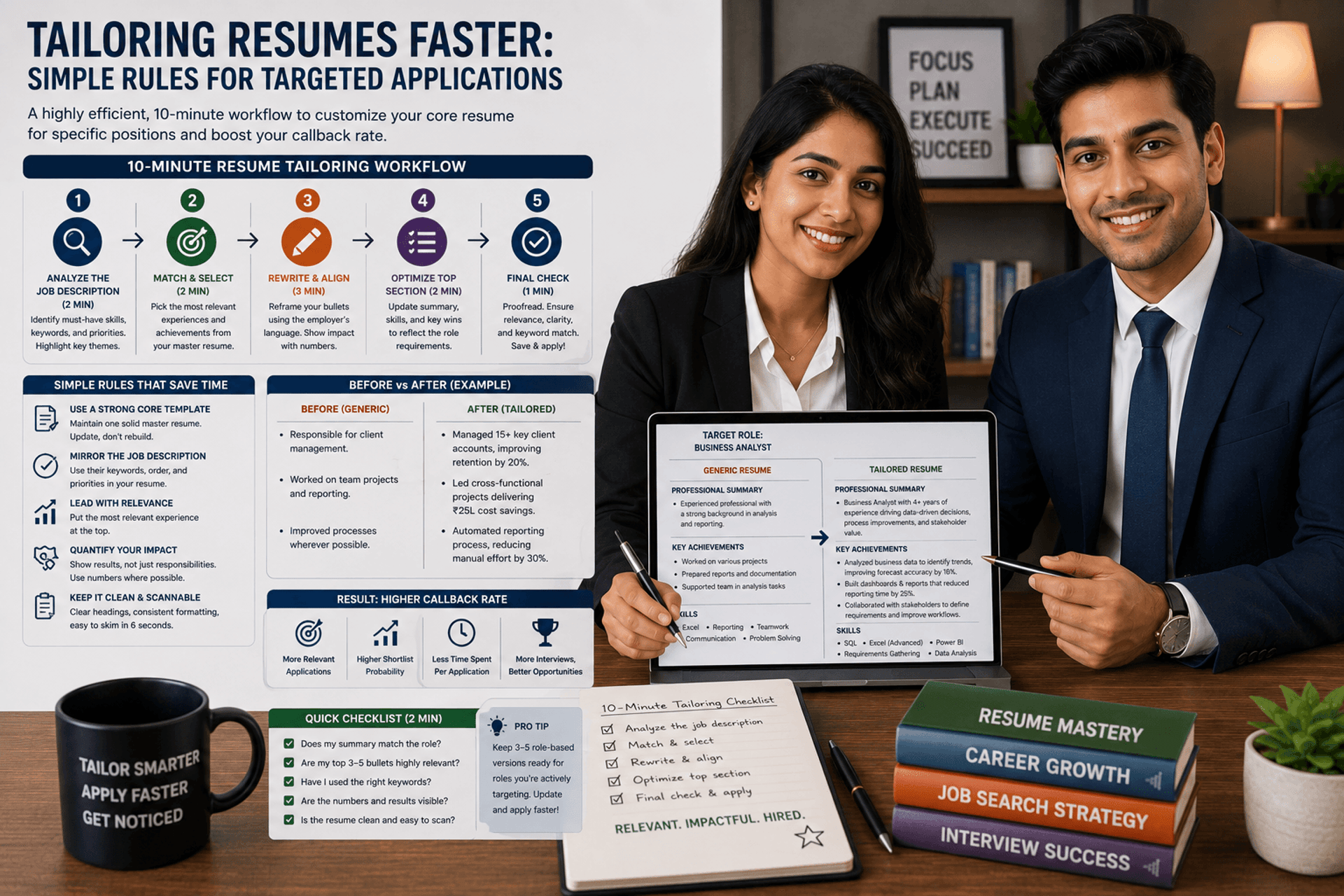
Building Fast, Targeted Resumes

Introduction
Mass-applying to dozens of different roles with a single, generic resume is an inefficient strategy that routinely triggers automatic rejections. Modern automated screeners and human talent acquisition teams scan applications for precise alignment with their open mandates. If your profile does not instantly address their specific pain points, it is passed over.
However, tailoring your resume does not mean rewriting your entire professional history from scratch for every application. By building a master resume template and using a systematic, targeted workflow, you can optimize your profile for specific positions in less than 10 minutes.
The Master Template Architecture
The foundation of a rapid customization workflow is a comprehensive, multi-page Master Resume. This document acts as your private internal database; it is never shared with employers.
Your master document contains every project, metric, tool, certification, and responsiblity you have ever held across your career, spanning three or more pages. When a target role opens up, you do not write a new document; you simply save a copy of this master file and delete the points, skills, or projects that are not relevant to that specific job description. This curation process ensures your final, customized profile remains focused and compact.
The 10-Minute Optimization Workflow
To customize your resume quickly and systematically, break the process down into four time-boxed operational phases.
Phase 1: The 2-Minute Job Description Audit
Open the target job posting and locate the top three recurring requirements listed under the "Responsibilities" or "Ideal Candidate" sections. These top requirements represent the core problems the employer needs solved. If an operations posting emphasizes "vendor consolidation" and "cross-functional logistics," those are your guiding pillars.
Phase 2: The 3-Minute Header & Directory Realignment
Review your skills directory. Move the technical tools and functional methods that match the job's top three requirements to the front of your lists. If the posting prioritizes a specific tool like SQL over another like Python, adjust your skills line to list SQL first.
Phase 3: The 4-Minute Bullet Point Calibration
Review the bullet points in your most recent professional roles. Rewrite the first two lines of your experience section so they lead with the exact vocabulary used by the employer.
If the job description asks for: "Optimizing customer lifecycle retention."
Adjust your core bullet point to read: "Optimized customer lifecycle retention workflows, reducing user churn by 14% through the deployment of data-backed automated engagement sequences."
Phase 4: The 1-Minute Quality & Verification Check
Scan the final document to ensure it fits perfectly within your strict page limits (1 page for early-career, 2 pages for experienced professionals). Ensure all remaining text rows align with the target role, and export the file as a clean, professionally named PDF.
Targeted Customization Grid
The table below shows how a single, generic background should be customized differently depending on the focus of two distinct job descriptions:
Scaling Your Application Output Without Sacrificing Contextual Relevance
Rewriting your entire resume for every single job application is an inefficient, low-yield strategy. This operational blueprint details how to maintain a comprehensive master profile and deploy rapid, high-impact adjustments to your skills directory and top summary block to match job mandates in under ten minutes.
Key Benefits of This Strategy
Maximizes Application Velocity: Implementing a structured modular editing system allows you to submit highly customized, high-scoring applications to multiple target firms per day without burning out.
Guarantees High Contextual Relevance: Adjusting only the most visible text zones ensures that your document directly addresses the immediate operational pain points outlined in the employer’s job posting.
Tactical Protocol: Do's and Don'ts
Follow this strict customization checklist to keep your optimization process fast, accurate, and disciplined:
Workflow & Speed Optimization
✅ DO maintain a single, exhaustive Master Resume file that serves as the central data source for your applications.
✅ DO focus your customization efforts primarily on the top half of your first page, as this is where recruiters look first.
❌ DON'T spend hours rewriting historical, junior-level roles; keep your focus on your most recent positions.
❌ DON'T start editing your document without first identifying the employer's top three core requirements.
Content Integrity & Naming
✅ DO save your final file using a professional naming convention that includes your name and the target domain (e.g., Firstname_Lastname_Operations_Resume.pdf).
✅ DO ensure your customized achievements remain fully verifiable and backed by real business outcomes.
❌ DON'T adjust your past official job titles to match a job description if they mismatch your official employment verification letters.
❌ DON'T leave irrelevant certifications or outdated technical proficiencies on a highly targeted application.
_____________________________________________________________________________________________
RESUME & COVER LETTER WRITING
Tailoring Resumes Faster: Simple Rules for Targeted Applications
Deploying an efficient, 10-minute workflow to customize your
core template for specific job openings.
Conclusion
Tailoring your resume is a structured, highly efficient exercise in content curation rather than a creative writing task. By utilizing a comprehensive master document and dedicating 10 minutes to aligning your terminology, skills, and top achievements with the employer's requirements, you significantly improve your application response rates. Once your core resume strategy is optimized for targeted applications, your next objective is building the supporting narrative that introduces your file.
Our next article explores this narrative architecture: The Anatomy of a Winning Cover Letter: Writing Your Story in 300 Words.
Related Articles
JobPark India © 2026 | All Rights Reserved
_____________________________________________________________________________________________________________________________________________
JobPark
"Empowering India's Workforce Journey"
JobPark is a free career guidance platform focused on practical, India‑specific workplace insights. We help students, job seekers, and professionals navigate career growth, workplace practices, and skill development with clarity, confidence, and real‑world relevance.
Career Journey
Quick Links
Career Support
🌟 Free forever. No strings. Just JobPark.
Career Resources Directory