Resume vs. CV: Understanding Global and Indian Recruiter Expectations
Job seekers frequently use the terms "Resume" and "CV" interchangeably, yet submitting the wrong document can instantly stall an application.
RESUME WRITING
Updated 7 July 2026
7/7/20263 min read
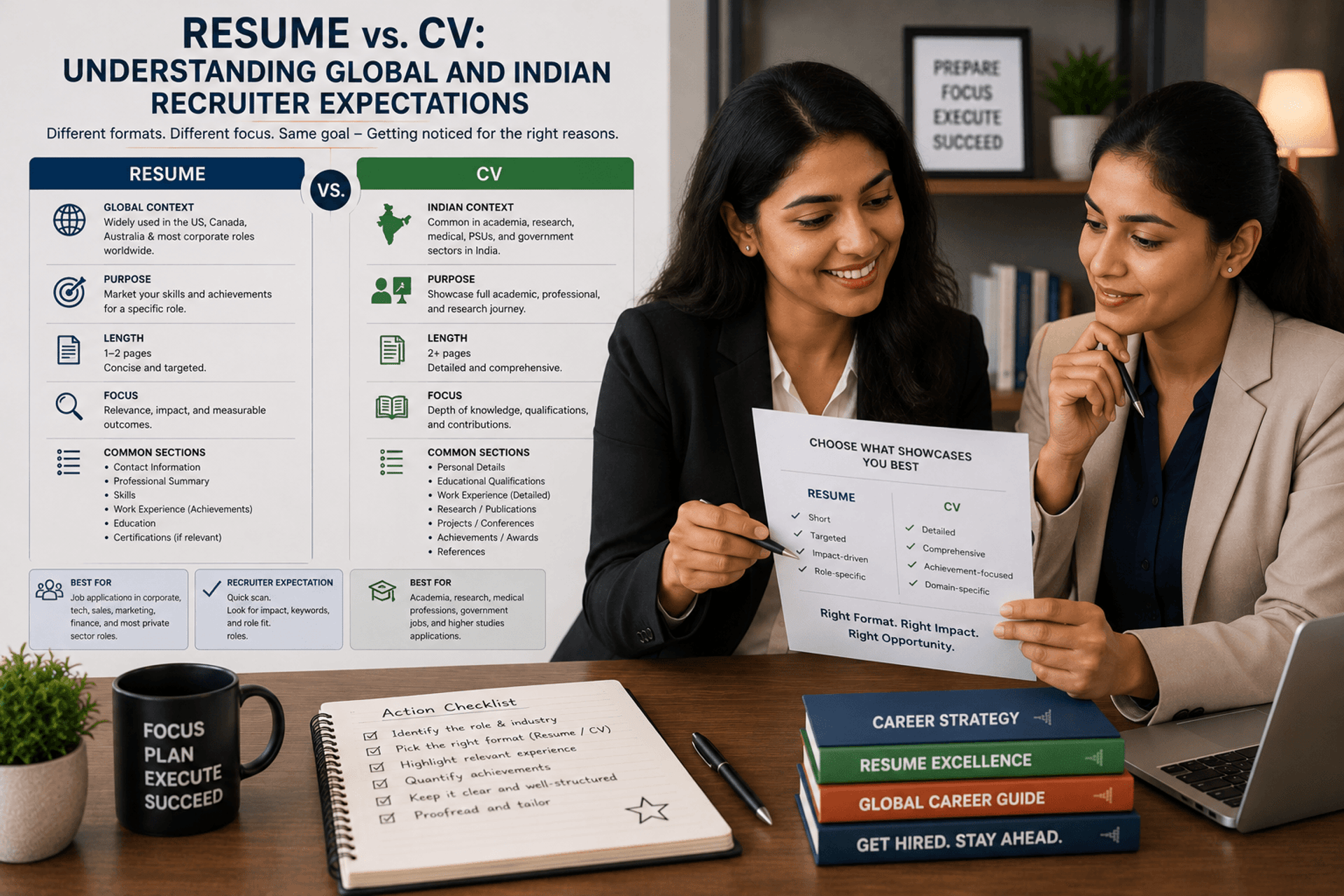
Using The Precise Format

Introduction
Job seekers frequently use the terms "Resume" and "CV" interchangeably, yet submitting the wrong document can instantly stall an application. Recruiting workflows rely on automated filtering and rapid human screening. To ensure your application advances, you must deploy the precise format that matches the geographic location, industry, and seniority level of your target role. Understanding these distinctions prevents formatting errors and positions you as a calculated, globally aware professional from the very first scan.
The Core Structural Differences
Understanding the operational variance between these two documents is the first step toward building a high-impact application.
Regional Context: India vs. The Global Market
Recruitment terminology shifts significantly across borders. Navigating these regional nuances ensures your document aligns with local hiring expectations.
1. The Indian Market Dynamics
In India, the terms are structurally blended in corporate speech, but clear operational boundaries exist based on your experience level:
Freshers and Early-Career Professionals: Corporate recruiters look for a crisp, action-oriented Resume (1–2 pages) highlighting internships, academic projects, technical proficiencies, and leadership roles.
Senior Executives and Tech Leads: While often colloquially requested as a "CV," leadership profiles should still follow the structural discipline of an advanced resume. Keep it focused on organizational impact, scale, and financial metrics across a maximum of 2 to 3 pages.
The Traditional "Biodata": This format is obsolete for corporate hiring. Avoid including highly personal variables such as age, marital status, religion, or parental occupations, as modern Indian HR frameworks prioritize objective talent metrics.
2. North America (US & Canada)
The boundary here is rigid and strictly enforced:
The Corporate Standard: Use a Resume. Any multi-page document resembling a CV submitted for a commercial corporate role is routinely rejected for lack of brevity.
The Academic Standard: Reserve the CV exclusively for applications in medicine, scientific research, teaching tracks, or institutional grants.
3. United Kingdom, Europe, and New Zealand
In these regions, the word CV is the default term used for all job applications. However, the document they expect is functionally identical to a North American corporate Resume—a highly tailored, metrics-driven document restricted to 2 pages. True academic CVs in these regions are explicitly designated as "Academic CVs."
Strategic Evaluation: Which Document Do You Need?
To select the correct document format, evaluate your current career trajectory against three core parameters:
Choose an Advanced Resume If:
You are applying for commercial corporate roles, engineering positions, product management, financial sectors, or startup operations.
Your primary goal is to pass high-volume automated screenings and capture a recruiter’s attention within a 6-second window.
Your career equity is best demonstrated through recent, quantifiable business outcomes rather than institutional publications.
Choose a Curriculum Vitae (CV) If:
You are pursuing a tenured faculty track, scientific research fellowship, or clinical medical residency.
The application explicitly requests comprehensive documentation of your peer-reviewed journals, book chapters, presentations, and teaching grants.
You are applying for an international research grant where structural brevity is secondary to a complete record of scholarly achievements.
Navigating Regional Standards and Document Formats
Choosing between a resume and a CV depends entirely on your geographical target market and industry sector. This framework outlines the core differences in length, structure, and expectations between international application paths and the Indian hiring ecosystem.
Key Benefits of This Strategy
Prevents Immediate Rejection: Submitting a detailed, multi-page CV to an international corporate firm that expects a concise, single-page resume will cause your application to be discarded immediately for failing to meet standard layout limits.
Aligns with Local Verification Norms: Structuring your profile to include background details like comprehensive academic histories and permanent addresses when applying to traditional sectors in India fulfills local compliance expectations upfront.
Tactical Protocol: Do's and Don'ts
To guarantee your application aligns with institutional expectations, follow this structural execution checklist:
The Advanced Resume
✅DO restrict the layout to 1–2 pages with a dense focus on performance metrics and targeted key competencies.
✅DO customize the content for every application to directly address the specific core requirements of the job description.
❌DON'T use generic, passive phrases like "responsible for maintaining systems"; replace them with data-backed outcomes.
❌DON'T include personal bio-data details like your birth date, marital status, or photograph for corporate applications.
The Curriculum Vitae (CV)
✅DO include every academic publication, research grant, presentation, teaching credential, and institutional honor chronologically.
✅DO maintain a clean, standardized typographic hierarchy across all pages to preserve readability despite extreme length.
❌ DON'T compress or omit historical academic milestones simply to fit an arbitrary page limit.
❌DON'T use stylized corporate templates; stick to structured, formal, and highly readable academic layouts.
_____________________________________________________________________________________________
RESUME & COVER LETTER WRITING
Resume vs. CV: Understanding Global and Indian Recruiter Expectations
Resume vs. CV: Understanding Global and Indian Recruiter Expectations
Conclusion
Selecting the correct framework prevents structural rejection before an expert ever reviews your credentials. Whether you require a hyper-targeted corporate resume or an exhaustive, scholarly curriculum vitae, aligning your presentation with regional and industry standards is essential to proving your professionalism. For corporate and commercial growth tracks, your immediate priority is to translate your history into a modern, concise format designed for rapid verification.
Our next article explores the execution of this strategy: Modern Indian Resume Format: Clean layout, formatting, and structural standards.
Related Articles
JobPark India © 2026 | All Rights Reserved
_____________________________________________________________________________________________________________________________________________
JobPark
"Empowering India's Workforce Journey"
JobPark is a free career guidance platform focused on practical, India‑specific workplace insights. We help students, job seekers, and professionals navigate career growth, workplace practices, and skill development with clarity, confidence, and real‑world relevance.
Career Journey
Quick Links
Career Support
🌟 Free forever. No strings. Just JobPark.
Career Resources Directory