Modern Indian Resume Format: Clean Structure, Layout, and Design Rules
In a high-velocity job market, visual clarity dictates whether your resume is read or discarded. Recruitment professionals spend an average of six seconds on an initial structural review.
RESUME WRITING
Updated 7 July 2026
7/7/20264 min read
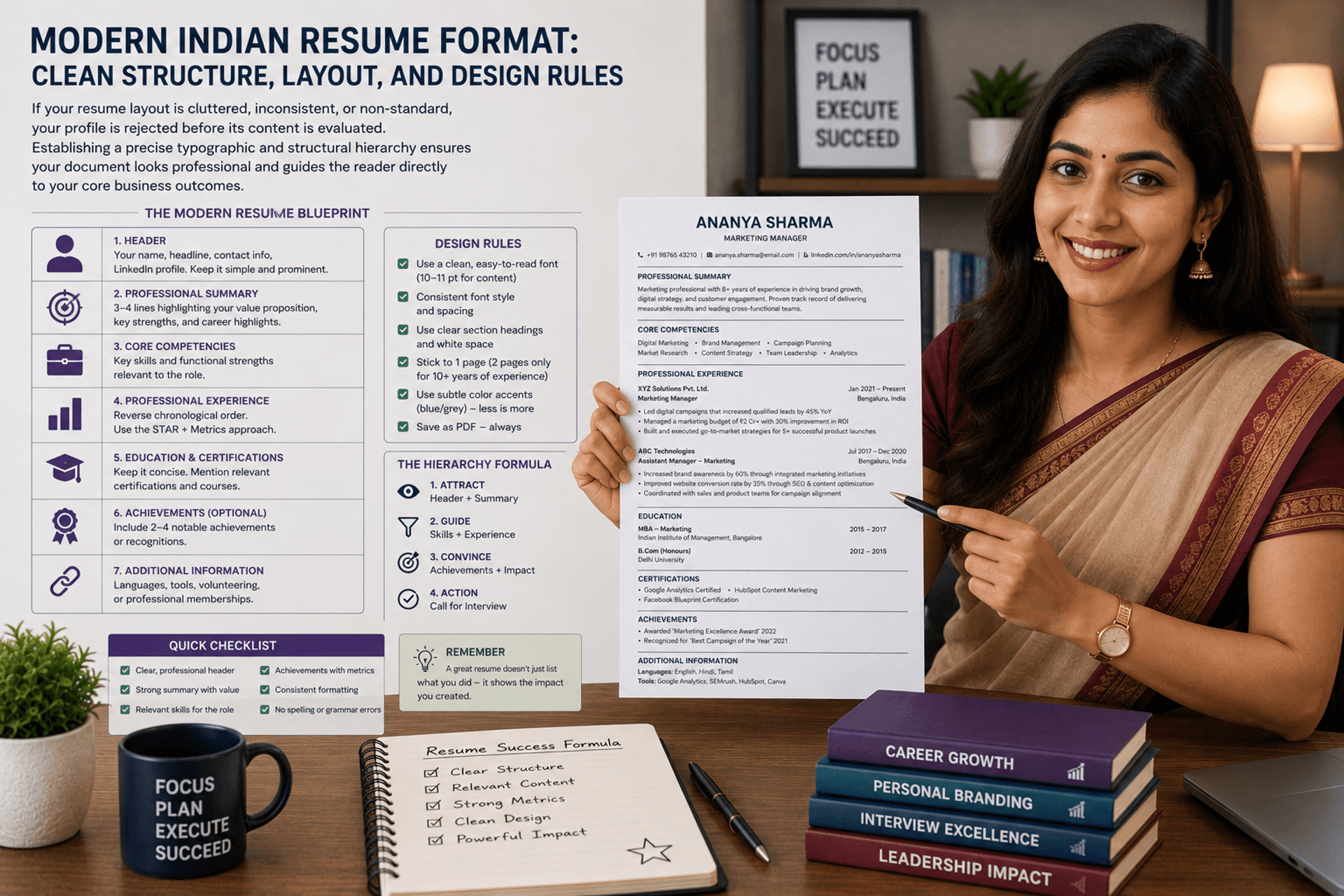
Building Modern Resume

Introduction
In a high-velocity job market, visual clarity dictates whether your resume is read or discarded. Recruitment professionals spend an average of six seconds on an initial structural review. If your layout is cluttered, inconsistent, or non-standard, your profile is rejected before its content is evaluated. Establishing a precise typographic and structural hierarchy ensures your document looks professional and guides the reader directly to your core business outcomes.
Core Layout Parameters and Geometric Constraints
A professional layout relies on rigid geometric consistency. Deviating from standard margins or font scales breaks the visual grid and signals a lack of attention to detail.
Page Constraints: Strictly limit your document to 1 page for freshers and professionals with under 5 years of experience. Use 2 pages maximum for mid-career and senior professionals.
Margin Scale: Set margins to exactly 0.5 inches (all sides) for content-dense resumes, or 0.75 inches if you have less content. Never use 1-inch margins, as they create excessive dead space.
Typography Selection: Use a clean, highly readable Sans-Serif font such as Arial, Calibri, or Helvetica. Alternatively, opt for a modern Serif font like Garamond or Georgia if applying for legacy industries like finance or law.
Sizing Hierarchy:
Candidate Name: 16–18 pt (Bold)
Section Headings: 12–14 pt (Bold, ALL CAPS optional)
Body Text & Bullet Points: 10–11 pt (Regular)
The Contact Header: What to Include and What to Delete
The top section of your resume must be clean and purely functional. Modern Indian corporate HR standards prioritize objective professional data over personal identifiers.
Mandatory Inclusion Matrix
Full Name: Match the name listed on your official identification documents.
Professional Email: Use a clean, corporate format (e.g., firstname.lastname@email.com). Avoid childhood handles or complex numbering.
Primary Contact Number: Include your mobile number with the country code (+91 for India).
Current Location: State and city only (e.g., Bengaluru, Karnataka). A full residential address is unnecessary and creates clutter.
LinkedIn Profile URL: Clean up your custom URL (e.g., linkedin.com/in/username) to keep the text string compact.
Prohibited Elements (The Redundancy Filter)
Critical Update: Do not include your photograph, date of birth, marital status, gender, religion, or permanent home address. Including these variables consumes valuable space and risks introducing implicit bias into the evaluation pipeline.
Section Architecture: Ordering Your Career Equity
The structural flow of your resume depends entirely on your current career stage. Organize your layout so that your most compelling qualifications appear on the top half of the page.
1. The Professional (Mid-Career & Experienced)
If you have established corporate experience, your work history is your highest asset.
Header (Contact details)
Professional Summary (A brief, 3–4 line value statement; no generic objectives)
Core Technical & Functional Skills (Categorized directory)
Advanced Professional Experience (Chronological employment history)
Academic History (Degrees, institutions, and graduation years)
Certifications & Projects (Relevant industry validations)
2. The Early-Career Professional (Freshers & Under 2 Years Experience)
When professional tenure is limited, elevate your academic training, practical projects, and verifiable technical proficiencies.
Header (Contact details)
Education Background (Degrees listed in reverse chronological order)
Technical & Core Skills (Languages, tools, and platforms)
Academic & Personal Projects (Practical execution examples)
Internships & Training (Any industry exposure)
Co-Curricular Achievements (Leadership roles, competitions, or hackathons)
Chronological vs. Functional Designs: Selecting Your Strategy
The visual framework you choose determines how smoothly a recruiter can map your career trajectory.
A) The Chronological Layout (Recommended Standard)
This framework catalogs your work history in reverse chronological order, starting with your current or most recent position. It provides a transparent view of your career velocity and is highly preferred by both recruiters and automated screening software. Use this layout if your career follows a steady path within the same domain.
B) The Functional/Hybrid Layout (Alternative Option)
This framework shifts the emphasis from timelines to specific skill clusters. While it can help obscure employment gaps or facilitate a drastic industry transition, it should be deployed cautiously. Recruiters often look at pure functional layouts with skepticism, preferring to see exactly when and where a capability was executed.
Architecting High-Stature Grid Layouts for Corporate and Tech Ecosystems
The domestic corporate landscape requires an absolute balance between fast machine scannability and specific background data fields. This blueprint outlines the exact structural geometry, text hierarchies, and section sequences required to stand out within premium Indian enterprises.
Key Benefits of This Strategy
Accelerates Recruiter Screening Time: Replacing chaotic, multi-column graphic layouts with a standardized single-column template allows corporate reviewers to scan your career history, metrics, and academic standing within 6 seconds.
Minimizes ATS Parsing Failures: Using clean, system-supported fonts and strict text vectors ensures your document is processed accurately by automated applicant tracking engines commonly used by major Indian IT, tech, and financial enterprises.
Tactical Protocol: Do's and Don'ts
To guarantee your document aligns with the highest corporate formatting standards, follow this design execution checklist:
Formatting & Design Rules
✅ DO use a consistent grid with uniform margin alignments and standard, clean horizontal dividers to separate sections.
✅ DO stick to a clean, monochromatic layout (black text on a white background) with dark navy or charcoal accents restricted strictly to headings.
❌ DON'T use multi-column layouts, custom icons, rating bars, or graphics, as they disrupt automated screening tools.
❌ DON'T use bright, neon, or pastel colors that compromise readability and diminish the document's authoritative tone.
Content & Header Rules
✅ DO list your technical competencies in a clean, categorized directory using plain text formatting.
✅ DO format your contact details into a single, space-efficient line directly beneath your name.
❌ DON'T include personal biodata details such as age, religion, marital status, or photographs.
❌ DON'T waste the top section of your page on a generic, text-heavy "Career Objective" statement.
_____________________________________________________________________________________________
RESUME & COVER LETTER WRITING
Modern Indian Resume Format: Clean Structure, Layout, and Design Rules
Modern Indian Resume Format
Conclusion
Adhering to a standardized, mathematically precise format ensures your resume instantly signals professionalism to human reviewers. By establishing a rigid typographic hierarchy and eliminating redundant biographical data, you clear away clutter and keep the recruiter's focus entirely on your professional outcomes. Once your visual foundation is flawlessly aligned, your next priority is ensuring the file can be read seamlessly by automated infrastructure.
Our next article addresses this technical interface: Passing the ATS: Building a Clean, Machine-Readable Resume.
Related Articles
JobPark India © 2026 | All Rights Reserved
_____________________________________________________________________________________________________________________________________________
JobPark
"Empowering India's Workforce Journey"
JobPark is a free career guidance platform focused on practical, India‑specific workplace insights. We help students, job seekers, and professionals navigate career growth, workplace practices, and skill development with clarity, confidence, and real‑world relevance.
Career Journey
Quick Links
Career Support
🌟 Free forever. No strings. Just JobPark.
Career Resources Directory