📄Crafting Resumes and Cover Letters That Get Results: The Indian Professional’s Blueprint (FOUNDATIONAL ARTICLE)
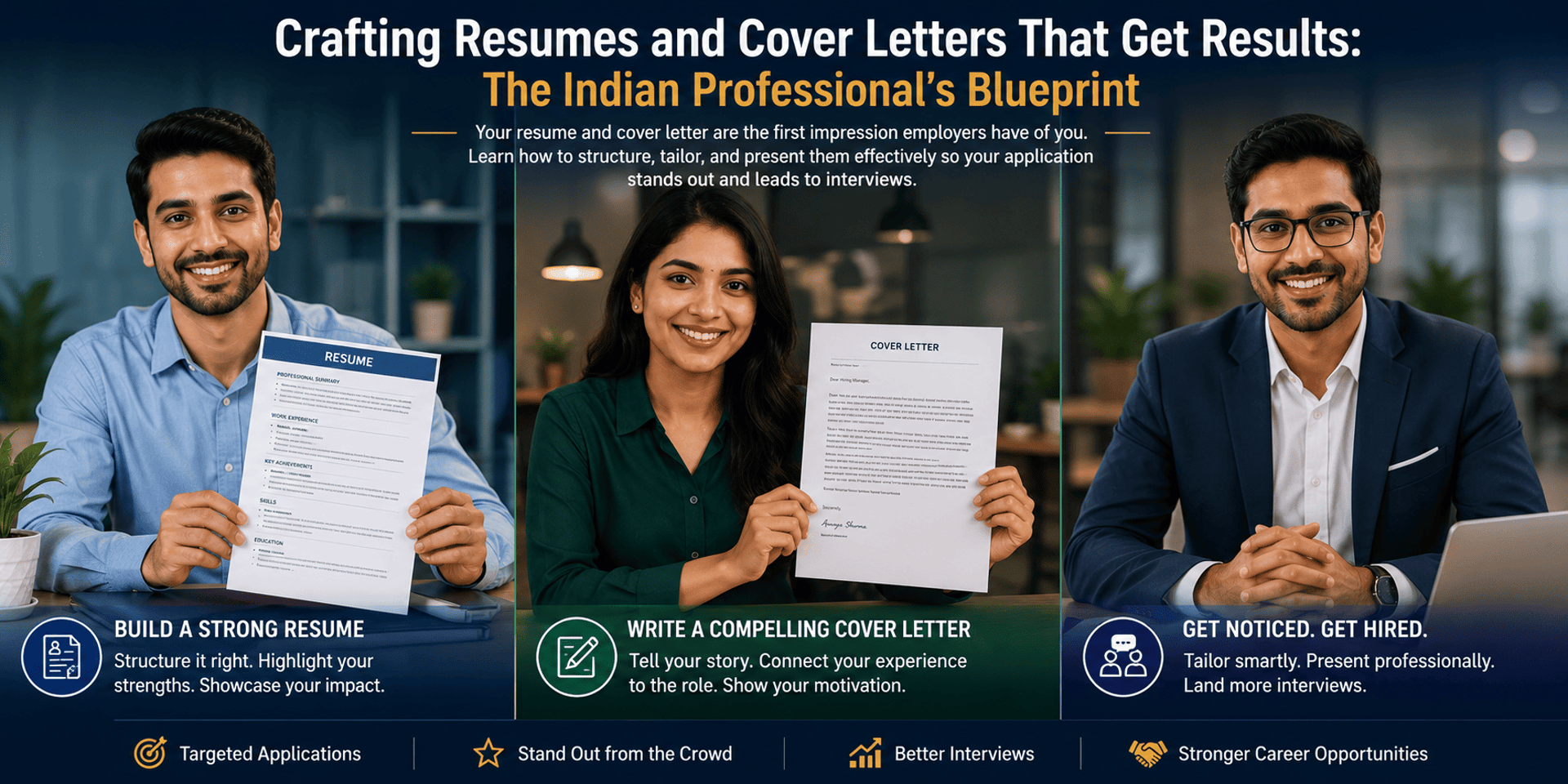
Master the subtle architecture of high-impact job applications. This operational blueprint details how to transition your resume from a simple list of duties to an authoritative showcase of scale, localized business context, and high-yield professional milestones.
RESUME WRITING
Updated 19 Jun 2026
5/10/20266 min read
Introduction
Most job seekers fail not due to a lack of capability, but because their professional documents fail to communicate their true value on first glance. This comprehensive guide strips away the fluff to present a clear, data-backed blueprint for crafting resumes and cover letters that explicitly prove your impact. You will learn how to articulate localized business achievements, balance technical skills with leadership traits, and create highly targeted narratives that resonate with decision-makers across fast-growing domestic sectors.
Your resume and cover letter are not mere summaries of your employment history; they are high-impact marketing documents. Their sole metric of success is whether they convert a cold database entry into a live interview call. To achieve that, your application strategy must be tailored specifically to navigate the technical and cultural filters of the modern Indian corporate landscape.
1. The Dual-Component Strategy: Data vs. Narrative
Think of your application as a highly optimized, two-part marketing funnel:
The Resume is the Data Layer: It must be structured for immediate machine readability and rapid human scanning (typically under 6 seconds). It answers what you achieved, how you did it, and where you fit operationally.
The Cover Letter is the Narrative Layer: It provides strategic context. It bridges the gap between your past experience and the employer's immediate pain points, answering why you are uniquely equipped for this specific role.
_____________________________________________________________________________________________
2. Structuring an Indian-Market Resume for Impact
Recruiters at major Indian enterprises scan hundreds of profiles daily. If they cannot find your core qualifications, location, and availability instantly, they will move to the next candidate.
The Critical Logistics Header: Unlike Western resume formats where personal logistics are minimized, Indian recruiters heavily screen for operational constraints early. Place your Current Location (and willingness to relocate) and your Notice Period (e.g., Immediate, 30 days, 90 days) directly under your contact details at the top.
The Chronological Default: Use a reverse-chronological format unless you are completely changing careers. Lead with your most recent experience, as recruiters value your current peak capabilities and recent technical stack above all else.
The Length Rule: Keep it to a single page if you have under 5 years of experience. For seasoned professionals, cap it strictly at two pages. Every single line must earn its place.
_____________________________________________________________________________________________
3. Beating the ATS Bot
Before a human recruiter ever eyes your resume, it will likely pass through an Applicant Tracking System (ATS). To ensure your resume doesn't get automatically dropped by the system, follow these structural rules:
Kill the Complex Design: Avoid multi-column grids, embedded charts, icons, infographics, and floating text boxes. ATS parsing engines read left-to-right across a page; complex columns scramble your text into an unreadable mess of characters.
Keyword Alignment: Analyze the target Job Description (JD). If the JD repeatedly mentions "Stakeholder Management," "SQL Data Modeling," or "Cross-functional Collaboration," ensure those exact phrases are naturally embedded in your bullet points.
Standardize Section Headers: Stick to universally recognized text headers like Professional Experience, Core Competencies, Education, and Technical Certifications. Do not use creative labels like “Where I’ve Been” or “My Superpowers.”
_____________________________________________________________________________________________
4. Quantifying Achievements with the X-Y-Z Formula
The single biggest mistake Indian job seekers make is listing generic daily responsibilities instead of actual achievements. Do not copy-paste your old official job description. Instead, use the Google X-Y-Z formula to prove your performance data:
Accomplished [X], as measured by [Y], by doing [Z].
Weak (Responsibility-focused): "Handled client onboarding and managed team deliverables."
Strong (Impact-focused): "Accelerated client onboarding velocity by 25% (X) over two quarters (Y) by designing a standardized transition playbook and upskilling a 4-member execution team (Z)."
_____________________________________________________________________________________________
5. Writing Cover Letters That Scale
Let’s be candid: in mass corporate hiring in India, recruiters rarely read traditional, multi-page cover letters. However, a highly tailored, short-form cover letter is incredibly powerful when applying directly to startup founders, boutique consulting partners, or when reaching out directly via email or LinkedIn.
Keep your cover letter to a punchy 3-paragraph structure (under 150 words):
Paragraph 1 (The Hook): State exactly who you are, the role/Job ID you are targeting, and how you found the opening.
Paragraph 2 (The Core Value): Highlight one or two major, quantifiable career wins from your resume that directly solve a current operational problem the target company is facing.
Paragraph 3 (The Logistic CTA): Explicitly restate your availability and notice period, and mention your enthusiasm for a formal interview.
_____________________________________________________________________________________________
6. Elimination of Legacy Redundancies
The Indian corporate ecosystem has modernized significantly. Including outdated, legacy details makes an application look archaic and out of touch with modern corporate culture.
Remove Personal Declarations: Delete details like your marital status, religion, gender, father’s name, permanent hometown address, or a passport-sized photograph (unless explicitly requested for forward-facing roles like aviation or hospitality).
Abolish the "Objective Statement": Vague entries like “Seeking a challenging position in a progressive organization to utilize my skills...” add zero value. Replace it with a 3-line Professional Summary that states your total experience, core domain stack, and your biggest career milestone.
_____________________________________________________________________________________________
Key Benefits of This Blueprint
Maximizes Domestic and Global ATS Clearance: Reveals the strict layout formats, single-column architectures, and keyword densities required to bypass automated screening filters used by major Indian corporates and global MNCs.
Establishes Localized Market Authority: Provides a clear framework for articulating professional scale using regional business context—such as correctly handling INR denominations (Lakhs/Crores) and managing matrixed regional teams.
Synchronizes Your Career Narrative: Harmonizes your custom-tailored resume metrics with a high-conversion cover letter, ensuring you present a single, unified professional identity to hiring boards and executive search firms.
Accelerates the Interview Pipeline: Shifts your positioning from a passive applicant to an active corporate solution provider, dramatically reducing the time spent in the initial screening rounds.
Transforming high-level strategy into a tangible corporate application requires a systematic, step-by-step approach.
The following Structural Execution Sequence outlines the exact phases needed to overhaul your personal marketing assets—moving methodically from initial layout alignment and localized impact metrics to final pre-submission quality audits. Follow this clear roadmap to build an application architecture that commands attention from premier domestic and international employers.
The Do's and Dont's of Resume Writing
📑The Do's: Strategic Actions for Success
✅ Tailor every resume and cover letter Optimize your resume keywords specifically for the targeted job description. Ensure your document layout uses clean, single-column text formatting and standard 1–2 page structures to clear Applicant Tracking Systems (ATS) without breaking automated screening engines.
✅ Highlight achievements with metrics Quantify your professional impact using the Google X-Y-Z formula. Use hard data, percentages, and financial metrics to demonstrate exactly how you created value, rather than merely copy-pasting generic daily responsibilities from old job descriptions.
✅ Keep formatting clean and professional Stick to standard black fonts like Arial or Calibri with clear, conventional section headers. Place your critical personal logistics—like your current location and exact notice period—right at the top header where time-crunched Indian recruiters scan immediately.
✅ Show concise value in your cover letter Keep your cover letter under 150 words using a punchy three-paragraph structure. Address immediate employer pain points and close with a clear, professional call-to-action that highlights your operational availability.
✅ Ensure absolute data alignment Verify that every date, job title, and metric on your resume matches your LinkedIn profile perfectly. Indian background verification (BGV) teams check these records rigorously, so consistency across all platforms is vital to maintaining professional credibility.
⚠️ The Dont's: Critical Pitfalls to Avoid
❌ Don’t use complex graphic templates Avoid multi-column layouts, embedded charts, infographics, and visual skill rating bars. These design elements confuse parsing software, causing the ATS to scramble your career history and automatically drop your profile.
❌ Don’t include legacy personal redundancies Eliminate outdated details such as your marital status, religion, gender, father’s name, or a passport-sized photograph. Modern Indian corporate standards prioritize objective capability over archaic personal disclosures.
❌ Don’t misrepresent your notice period Never claim to be an "Immediate Joiner" if you are legally bound by a 60- or 90-day notice period. Falsifying your availability destroys trust instantly and will lead to an immediate revocation of the offer letter during background checks.
❌ Don’t rely on generic, uncustomized templates Avoid copy-pasting the exact same cover letter or summary statement for vastly different roles. Recruiters can instantly spot robotic, generic applications that fail to connect your specific skills to the company's unique requirements.
❌ Don’t submit without strict quality control Never send out an application containing typos, grammatical errors, or formatting inconsistencies. Careless mistakes on a resume signal a lack of attention to detail, which can eliminate you from competitive screening rounds before a human even interviews you.
_____________________________________________________________________________________________
RESUME & COVER LETTER WRITING - FOUNDATION ARTICLE
Crafting Resumes & Cover Letters That Get Results | JobPark
Learn how to write resumes and cover letters that stand out in India’s competitive
job market. Discover formats, ATS tips, and strategies to highlight achievements
and connect with employers
Conclusion
Resumes and cover letters are strategic toolkits, not administrative paperwork. By structuring your resume for rapid human scanning, mapping your text to clear the ATS bot, and keeping your cover letter focused on immediate value creation, you dramatically increase your shortlisting conversion rates. Tailored, data-driven documents demonstrate professional credibility, turning cold applications into active interview loops.
Related Articles
JobPark India © 2026 | All Rights Reserved
_____________________________________________________________________________________________________________________________________________
JobPark
"Empowering India's Workforce Journey"
JobPark is a free career guidance platform focused on practical, India‑specific workplace insights. We help students, job seekers, and professionals navigate career growth, workplace practices, and skill development with clarity, confidence, and real‑world relevance.
Career Journey
Quick Links
Career Support
🌟 Free forever. No strings. Just JobPark.
Career Resources Directory