🤝 Mastering Workplace Etiquette & Soft Skills: Navigating Corporate Diplomacy and Cross-Cultural Collaboration (FOUNDATIONAL ARTICLE)
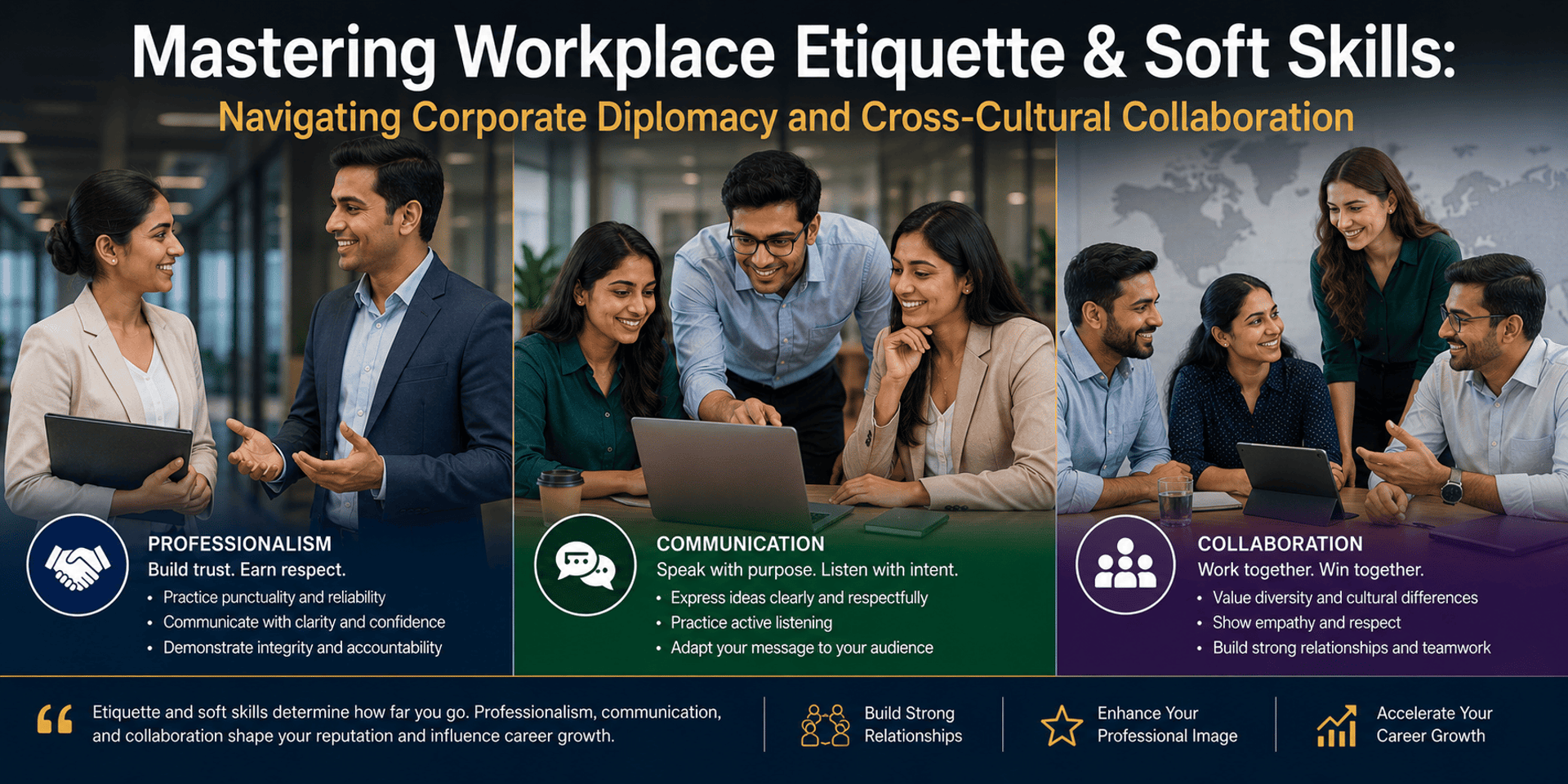
Technical expertise may get you hired, but etiquette and soft skills determine how far you go. Professionalism, communication, and collaboration shape your reputation and influence career growth. This guide provides practical strategies to help you strengthen workplace etiquette, build strong relationships, and develop the soft skills that employers value most.
SOFT SKILLS
Updated 22 Jun 2026
5/10/20266 min read


Introduction
Technical competence and domain expertise might get you through the door, but your workplace etiquette and soft skills determine your ultimate ceiling in an organization. In India’s highly matrixed corporate environments—where you routinely cross paths with traditional domestic hierarchies, fast-paced tech startups, and global onshore stakeholders—how you communicate, manage expectations, and handle conflict builds your professional brand.
Soft skills are not vague, secondary attributes; they are hard operational assets that act as a career multiplier. The ability to articulate complex data, lead cross-functional teams with empathy, and navigate boardroom politics smoothly is what differentiates an execution-level worker from a high-value leader. This guide provides a strategic framework to help you master the subtle nuances of local corporate diplomacy, digital communication hygiene, and cross-cultural collaboration.
1. Breaking the Deference Trap: Moving from "Sir" to Peer Equity
A unique structural challenge in the Indian corporate ecosystem is navigating the cultural transition between legacy, hierarchical top-down respect and the egalitarian, flat structures of modern MNCs and Global Capability Centers (GCCs).
Adopt First-Name Professionalism: Many professionals entering global workspaces carry the habit of addressing managers and clients as "Sir" or "Ma'am." In modern corporate cultures, this creates an artificial barrier to open communication. Transition confidently to using first names. It establishes peer equity and signals that you view yourself as a strategic collaborator rather than an administrative subordinate.
Balance Respect with Assertion: You can respect a senior executive's institutional experience without silencing your own domain insights. When presenting a counter-viewpoint to a leader, avoid overly apologetic language. Frame your perspective around data: “That is a valid historical baseline, but our current Q2 user telemetry indicates a structural shift, which is why I recommend this alternate approach.”
_____________________________________________________________________________________________
2. Digital Hygiene: Curbing Ping Spam and Mastering Asynchronous Communication
With remote and hybrid work models deeply embedded across Indian tech and corporate hubs, collaboration platforms like Slack, Microsoft Teams, and WhatsApp have become your primary workspaces. Poor digital etiquette on these channels quickly erodes professional credibility.
Eradicate the Naked "Hi" Ping: Avoid sending a lone, isolated message like "Hi" or "Hello" and waiting for the recipient to reply before typing your actual query. This creates unnecessary cognitive friction and disrupts focus. Use context-first messaging: state your greeting, your specific question, and your timeline or dependency in a single, well-structured block of text.
Respect Digital Boundaries: India's high-pressure work culture often blurs the line between professional availability and personal time. Unless an production server is down or a critical client deployment is failing, avoid sending non-urgent messages or calling colleagues outside of standard working hours. If you are working late and need to share updates, utilize the "Schedule Send" feature to deliver the message during their next active working window.
_____________________________________________________________________________________________
3. Mastering the Art of the "Strategic No"
A common cause of career burnout and missed deadlines among local professionals is the cultural conditioning to say "Yes" to every request from authority figures, even when facing an impossible workload. Over-promising and under-delivering destroys your professional reliability.
Deploy Data-Backed Boundary Management: When a manager attempts to hand you an unplanned project that threatens your existing delivery timelines, do not react with emotional resistance. Instead, lay out your current bandwidth transparently: “I am fully committed to delivering the client migration project by Friday. If we prioritize this new mandate today, it will push the migration timeline back by three working days. How would you like me to prioritize these two objectives?”
Offer Alternate Solutions: If you must decline a fast-tracked request, try to guide the stakeholder toward an alternative pathway. This positions you as a solutions-driven partner rather than a roadblock: “I cannot take on the data modeling block this week due to my current sprint commitments, but I can share my existing query templates to help your team fast-track the initial setup.”
_____________________________________________________________________________________________
4. Cross-Cultural Competence and Onshore Alignment
If you are working within a GCC or a multinational organization, a core part of your soft skill toolkit involves communicating with onshore teams across the US, Europe, or the APAC region. Managing these cross-border interfaces requires high adaptability.
Shift Away from Low-Context Communication: Western corporate communication relies heavily on high-context directness. Avoid ambiguous, open-ended phrases common in local slang, such as “I will do the needful” or “We will complete it loop-by-loop.” Use precise, explicit metrics: “The engineering team will patch the database bug and update the documentation repository by 4:00 PM IST tomorrow.”
De-escalate Time-Zone Friction: Managing asynchronous timelines across different geographies requires strict calendar discipline. Ensure your official calendar reflects your exact working hours in Indian Standard Time (IST), and when scheduling cross-border syncs, proactively propose windows that respect the working hours of both local and onshore participants.
_____________________________________________________________________________________________
5. Conflict Resolution and De-personalizing Corporate Friction
High-stakes delivery environments naturally create professional friction. The differentiator between mature leaders and execution-level workers is the capacity to navigate disagreements without damaging internal relationships.
Focus entirely on the Problem, Not the Person: When a project fails or a dependency is missed, avoid pointing fingers or assigning personal blame. Shift the team's collective energy toward root-cause analysis and operational remediation: “Our deployment failed because the staging environment lacked updated configuration keys. Let’s focus on automating our environment sync checks before our next production release.”
Empathize Across Generational Gaps: The modern Indian boardroom is a multi-generational mix of traditional, process-driven leadership and tech-native, boundary-focused younger workers. Navigating this landscape successfully requires you to act as a cultural bridge—listening actively to structural feedback from senior stakeholders while embracing the agile, execution speed of junior team members.
_____________________________________________________________________________________________
Succeeding in a highly matrixed corporate ecosystem
The following steps outline a deliberate approach to professional diplomacy, equipping you to build strategic trust, manage high-stakes communication channels, and seamlessly bridge cultural gaps between domestic teams and global stakeholders. Succeeding in a highly matrixed corporate ecosystem requires far more than technical execution—it demands a sophisticated command of interpersonal dynamics and cross-cultural communication.
Key Benefits of This Blueprint
Elevates Professional Authority and Stature: Teaches you how to project executive presence through high-impact communication strategies, active listening frameworks, and intentional non-verbal signals.
Mitigates Workplace Friction and Conflict: Provides tactical frameworks for handling difficult conversations, delivering constructive feedback, and de-escalating team friction with diplomatic precision.
Optimizes Global Cross-Cultural Collaboration: Equips you to navigate diverse cultural expectations, management styles, and communication nuances when working across international time zones.
Accelerates Leadership Progression: Positions you as a collaborative, politically astute leader capable of managing complex stakeholder relationships and cross-functional corporate environments.
The Do's and Don'ts of Workplace Etiquette & Soft Skills
The Do's: Strategic Actions for Success
✅ Communicate with crisp, context-first clarity Combine your professional greetings, explicit project requirements, and dependent timelines into a single, comprehensive message on collaboration platforms. Eliminating empty conversational pings saves valuable time, optimizes asynchronous workflows, and establishes your reputation as an efficient, professional communicator.
✅ Adopt first-name corporate hygiene Transition fully to addressing your managers, peers, and global cross-functional stakeholders by their first names within global matrix organizations. Shedding archaic titles helps establish a baseline of equal peer equity, breaks down collaboration barriers, and signals executive confidence to onshore leadership.
✅ Manage expectations with data-backed boundaries Protect your professional reliability and output quality by matching new work requests against your existing project commitments. When bandwidth is stretched, clearly articulate your current operational priorities to managers using data, allowing them to make informed decisions on resource allocation.
✅ Practice rigorous virtual meeting discipline Arrive on time for every scheduled sync, optimize your audio and video components beforehand, and maintain active professional presence throughout the call. Respecting your colleagues' calendars and minimizing background distractions shows strong corporate maturity and cross-border alignment.
✅ Champion psychological safety and active listening Build a collaborative, inclusive team culture by giving peers your full attention during strategic brain-storming sessions or high-stakes problem-solving calls. Respect diverse technical viewpoints and validate structural feedback to encourage transparent communication and stronger project outcomes.
⚠️ The Don'ts: Critical Pitfalls to Avoid
❌ Don’t send empty greetings on chat platforms Avoid pinging a colleague with a solitary "Hi" or "Good Morning" and stalling the conversation until they manually reply. This pattern disrupts daily concentration, stalls operational velocity, and signals a lack of structured communication discipline on enterprise messaging platforms.
❌ Don’t badmouth colleagues or air corporate grievances publicly Avoid venting about internal team friction, toxic workplace dynamics, or organizational policy updates on public channels or loose office groups. Airing unprofessional grievances damages your corporate reputation and can signal a lack of compliance maturity to talent leadership.
❌ Don’t engage in performative over-deference Avoid using overly submissive, passive, or apologetic language when your technical insights or strategic recommendations differ from a manager's view. Masking your professional expertise under an excess of deference keeps you trapped in an execution silo and limits your visibility for leadership promotions.
❌ Don’t let emotional reactivity derail conflict resolution Avoid taking code reviews, design rejections, or tough project feedback as a personal attack on your capabilities. Reacting defensively or aggressively during corporate friction fractures crucial team relationships, making it essential to remain calm and focused entirely on operational remediation.
❌ Don’t breach digital boundaries during off-hours Avoid sending casual text pings or making non-emergency phone calls to colleagues during their personal time or weekend windows. Respecting your team's mental well-being and off-hour boundaries reduces systemic burnout and models the exact type of sustainable professional culture you want to work in.
_____________________________________________________________________________________________
SOFT SKILLS - FOUNDATION ARTICLE
Mastering Workplace Etiquette & Soft Skills
| JobPark
Workplace success depends on more than technical skills — it’s about communication, professionalism, and collaboration. Learn practical strategies to strengthen etiquette and soft skills for lasting career growth.
Conclusion
Workplace etiquette and advanced soft skills are the core foundation of a sustainable, high-velocity career trajectory. In India's fast-moving, globally integrated corporate sectors, technical execution is merely your ticket to entry; your emotional intelligence, cross-cultural adaptability, and relationship diplomacy are what carry you into the executive suite. By shifting away from performative deference, streamlining your digital communication infrastructure, and setting data-driven boundaries with calm assurance, you take absolute control of your professional brand. Balancing high performance with structural empathy ensures you build a powerful, resilient career path that commands respect across borders.
Related Articles
JobPark India © 2026 | All Rights Reserved
_____________________________________________________________________________________________________________________________________________
JobPark
"Empowering India's Workforce Journey"
JobPark is a free career guidance platform focused on practical, India‑specific workplace insights. We help students, job seekers, and professionals navigate career growth, workplace practices, and skill development with clarity, confidence, and real‑world relevance.
Career Journey
Quick Links
Career Support
🌟 Free forever. No strings. Just JobPark.
Career Resources Directory